

TradeStation Review
Scored on 7 day-trading criteria
Best for: US traders who want deep charting, the Matrix depth ladder and direct routing, and who mostly trade long after 6:00 AM ET.
Rule note: FINRA replaced the $25,000 pattern day trader rule with intraday margin standards on June 4, 2026; US brokers have until October 20, 2027 to implement. TradeStation’s FAQ says the PDT designation and $25,000 minimum are no longer in effect and margin day trading now uses a $2,000 equity threshold.
Facts checked against the broker’s own pages on 20 October 2026. Research-based review, not a hands-on test.
Inside TradeStation: charts, Matrix and RadarScreen
How this section was prepared: Documentation and official interface examples checked October 19, 2026. This is a research-based walkthrough, not a firsthand execution or performance test. Vendor screenshots can show historical versions and example data. Greenwick may earn referral fees through links on this page.
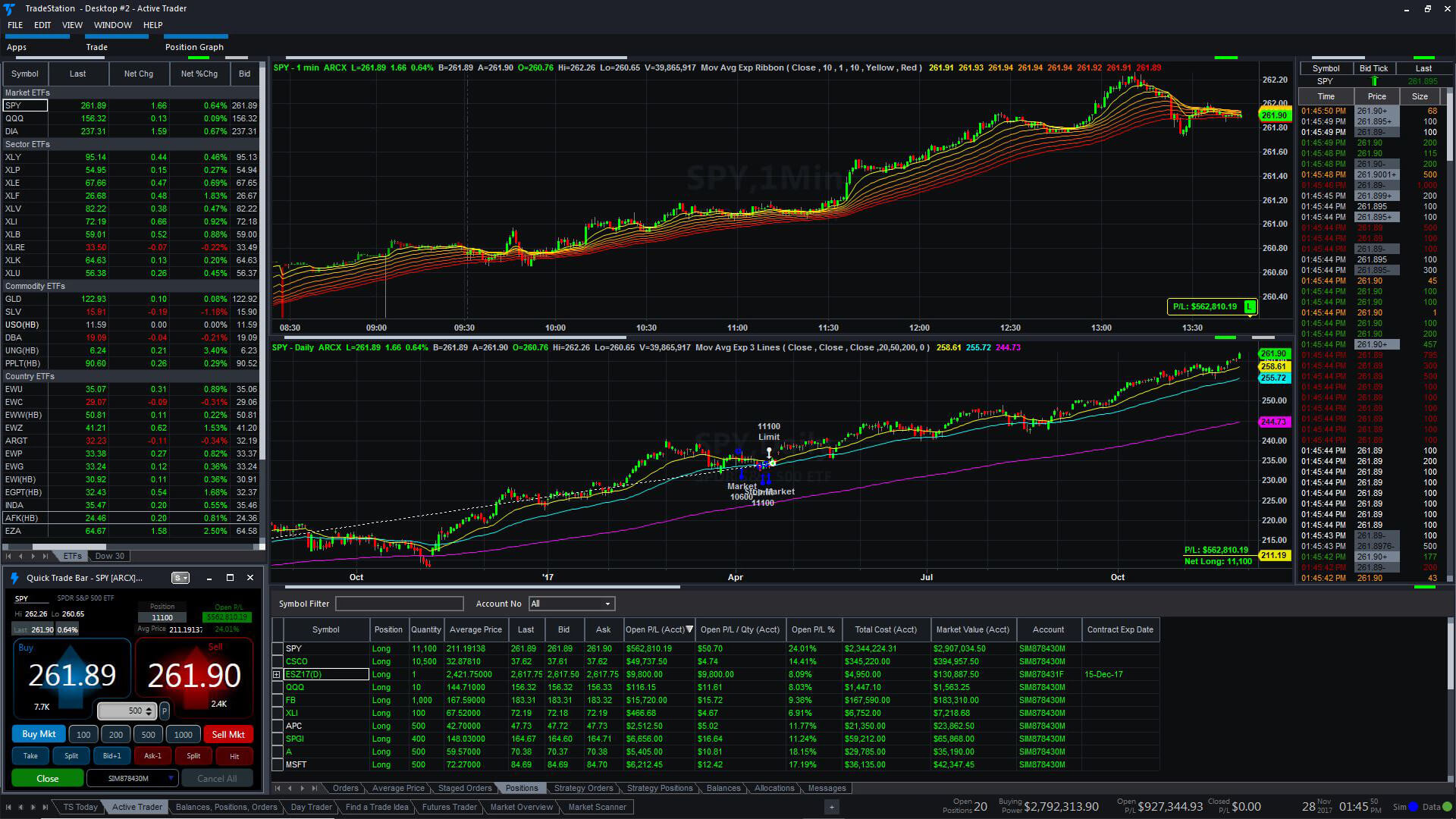
. Vendor example; not current market data or a Greenwick result. Official source. Open image for detail.
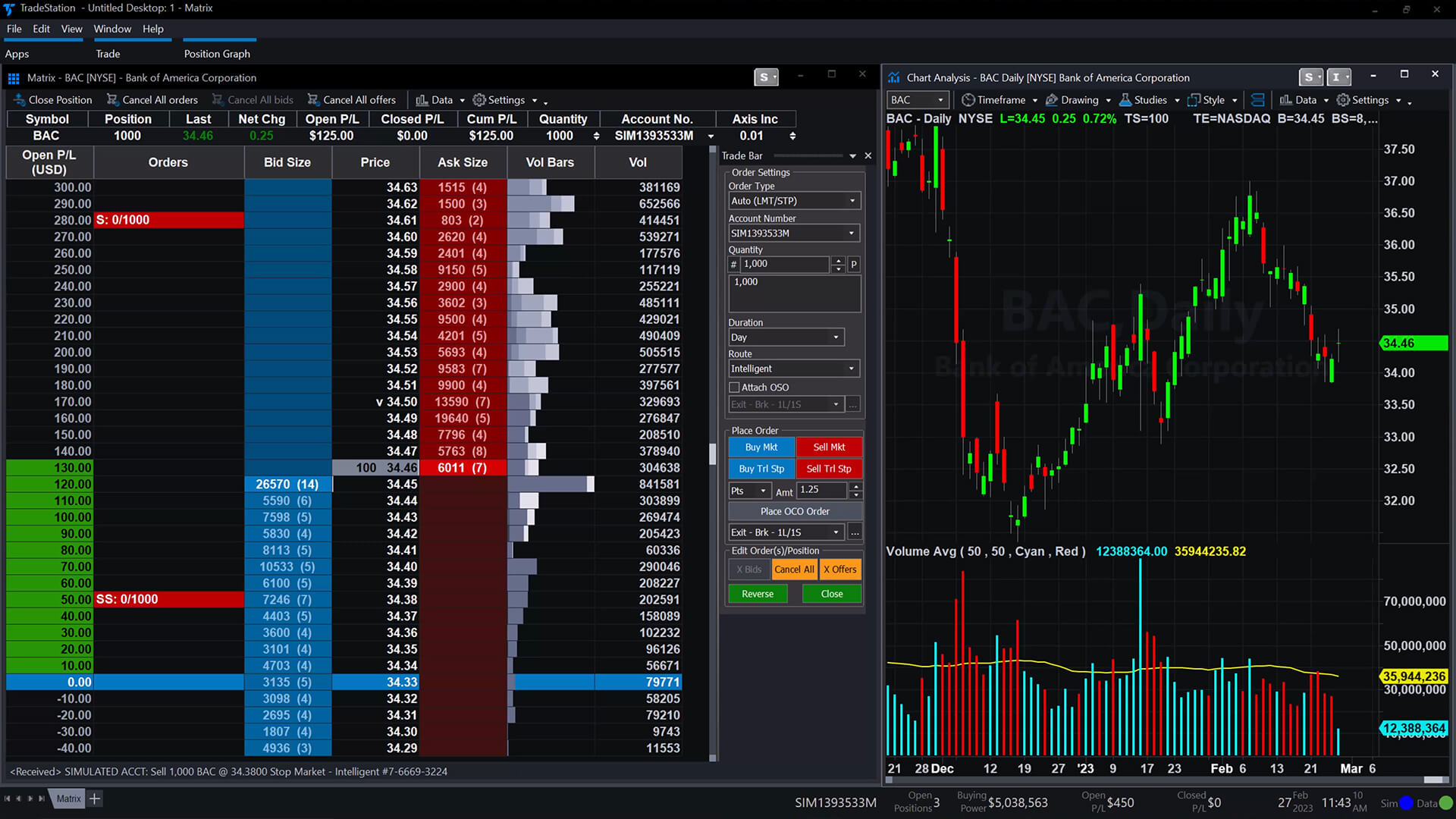
. Vendor example; not current market data or a Greenwick result. Official source. Open image for detail.
The chart and Matrix answer different questions
The official desktop examples below show chart analysis and the Matrix interface. A chart organizes historical price behavior; the Matrix brings depth and order tracking into a trading view. Check the selected instrument and account before comparing price levels between panels. Visible liquidity can change and does not guarantee a fill at the displayed price.
RadarScreen is a monitoring workflow
TradeStation describes RadarScreen as a way to monitor a symbol list using quote and indicator columns. That can help make a research process repeatable, but a matching cell is not a complete trade plan. Define the universe, interval and condition first, then review the candidate’s chart, activity and relevant company information.
EasyLanguage testing needs independent validation
The platform supports strategy development with EasyLanguage. Treat generated or copied code as a rule set to inspect. Establish when a signal becomes available, how fills and costs are modeled and whether results remain plausible on untouched data. A historical report is not evidence of a live execution advantage.
A practical evaluation workflow
- Build a short demonstration watchlist and use one consistent interval.
- Open the same instrument in a chart and the relevant depth or order panel.
- Practice a simulated order and inspect modification, cancellation and final position.
- If testing a strategy, preserve an untouched validation set and record assumptions.
Fit and trade-offs
TradeStation may fit a trader who wants programmable research and an integrated desktop. Complexity becomes a cost when the same task is already handled adequately by a simpler broker tool.
Primary references: TradeStation desktop tools · RadarScreen documentation
TradeStation at a Glance
| Who can open | US clients through TradeStation Securities, Inc. · Clients outside the US have their own price list (a $5.00 ticket charge per stock trade) · Canada: not covered on the pages we checked |
| Minimum to open | No cash-account minimum found · $2,000 to open or hold a margin or short position |
| Commissions (US clients) | $0 per share on stocks and ETFs · sub-dollar/OTC $0.005/share · direct routing $0.0048/share under 100,000 shares a month (down to $0.0032) · a per-share clearing fee is listed from $0.003 under 100,000 shares a month to $0 above 10 million |
| Platform fee | TradeStation desktop free with a brokerage account ($99.99/month without one) · inactivity fee $10/month unless minimum activity is met |
| Level 2 / market data | Non-professional funded equities accounts on eligible plans: NASDAQ Package #2 (Level 1 + Level 2) $11/month; Package #3 with TotalView $17/month and an Enhanced Market Depth prerequisite. Other non-professional customers may only access delayed data. Confirm bundle eligibility and fees with TradeStation. |
| Order routing | Intelligent (default) routing or direct routing at a per-share fee |
| Short locates | Hard-to-borrow: call the Equities Trade Desk, which will try to locate shares at no extra charge; short-debit fees vary · margin accounts only |
| Regulator & protection | FINRA member; SIPC up to $500,000 |
Checked 20 October 2026 against TradeStation’s pricing page, service fees, market data pricing, desktop page, FAQs, margin page and hot key help.
Who TradeStation Is For (by Region)
US: TradeStation Securities is a FINRA member and SIPC member. Cash accounts are available and, in TradeStation’s words, “day trade rules do not apply to cash accounts”. You cannot short in a cash account.
TradeStation is one of the few brokers that has already updated its PDT language. Its FAQ says the Pattern Day Trader designation and the $25,000 minimum are “no longer in effect”, and that day trading in a margin account now runs on a $2,000 margin equity threshold. That matches FINRA’s switch to intraday margin standards on June 4, 2026 (brokers have until October 20, 2027). One older FAQ line still mentions $25,000, so the page is not fully cleaned up.
Canada: we found no Canadian entity or Canadian pricing, so we scored Canada at zero.
International: TradeStation publishes a separate price list for clients outside the US. Stock trades carry a $5.00 ticket charge per trade on top of the same routing and clearing fees. Its FAQ suggests international residents may need paper applications. Protection is the same SIPC coverage, since accounts sit at the US firm.
Commissions, Platform & Market Data
For US clients, stock commissions are $0 a share. The extras sit underneath. Sub-dollar and OTC shares cost $0.005 a share. Direct routing costs $0.0048 a share for traders under 100,000 shares a month. The pricing table also lists a clearing fee of $0.003 a share at that tier, falling to $0 above 10 million shares. The page does not say whether it applies to every order or only direct-routed ones, so confirm before you budget.
Example: 2,000 shares of a $0.60 stock is $10.00 at the sub-dollar rate, before any clearing or regulatory fees.
The desktop platform is free with a funded account. There is a $10 monthly inactivity fee unless you meet minimum activity. TradeStation lists $11/month for non-professional NASDAQ Package #2 with Level 1 and Level 2, and $17/month for Package #3 with TotalView; the latter requires Enhanced Market Depth. Pricing applies to funded equities accounts on eligible plans.
Level 2, Tape & Pre-Market Charting
The Matrix is TradeStation’s depth ladder. It shows bid and ask size at each price, your working orders and volume bars, and you trade by clicking the ladder.
Pre-market starts at 6:00 AM ET, not 4:00 AM. TradeStation’s FAQ describes this as an extension of pre-market hours, with limit orders only. For gappers that move at 4:00 AM, that is a real gap. We did not find a halt indicator or a statement on how VWAP handles extended hours. Both scored at half. See halts, circuit breakers and SSR.
Hotkeys & Direct Routing
TradeStation supports order-entry hot keys and macros. Its help pages show how to assign a macro to a hot key and set a default order-entry hot key layout. We did not find documentation for price offsets or sizing by percent of position, so we gave partial credit.
Routing is a strength. Orders go through intelligent routing by default, and you can pick a direct route for a per-share fee. The Matrix order panel shows the route choice next to quantity. TradeStation does not mention order-size limits on low-priced stocks. For how routes affect fills, read order routing and Level 2.
Short Locates
Shorting needs a margin account with at least $2,000. Easy-to-borrow stocks short normally. For anything else, TradeStation says you can contact the Equities Trade Desk and it “will attempt to locate shares” at no additional charge. Short-debit fees still apply and vary.
There is no self-serve locate tool, no price shown in the platform before you borrow, and no credit for unused locates. Locates by phone are slow for a stock that is moving at 7:00 AM. Read short selling small caps for what a fast locate workflow looks like.
Trust, Safety & Records
TradeStation Securities is a FINRA member and a SIPC member, with coverage up to $500,000. It is a long-established US broker.
For records, TradeStation’s FAQ mentions tax-center exports in CSV format for tax software. We did not find a documented execution export for journaling, so we scored it at half. Test the export before you rely on it for an offline trading journal.
The Honest Breakdown
Pros
- $0 commissions for US clients on stocks above $1
- Matrix depth ladder with click trading
- Direct routing available per order
- Already updated its PDT language to the $2,000 margin threshold
- Cash accounts with no stated minimum
Cons
- Pre-market starts at 6:00 AM ET, not 4:00 AM
- Locates only by calling the trade desk
- NASDAQ Level 2: $11/month on eligible funded non-professional plans; TotalView package $17/month plus stated prerequisites
- $5 ticket charge for clients outside the US; no Canadian offer found
Sub-Score Breakdown
Scored on our 100-point rubric from TradeStation’s own pages (checked 20 October 2026). Not verified, scored at half: halt display, extended-hours VWAP, hotkey offsets, clearing-fee scope, execution export. How we rate brokers.
Scored on 7 day-trading criteria
TradeStation Questions
How do short locates work at TradeStation?
If a stock is not easy to borrow, you contact TradeStation’s Equities Trade Desk and it will try to locate shares. TradeStation says there is no extra charge for the locate itself, but short-debit fees apply and vary. Shorting needs a margin account with at least $2,000.
When does pre-market trading start at TradeStation?
TradeStation’s FAQ says pre-market trading for equities starts at 6:00 AM Eastern Time, with limit orders only. That is two hours later than brokers that open at 4:00 AM.
Does TradeStation still enforce the $25,000 pattern day trader rule?
TradeStation’s FAQ says the Pattern Day Trader designation and the $25,000 minimum equity requirement are no longer in effect. Day trading in a margin account is now governed by a $2,000 margin equity threshold. Cash accounts are not subject to day trade rules.
The Bottom Line
TradeStation has strong charts, the Matrix ladder and direct routing for US traders. For small-cap momentum, the 6:00 AM pre-market start and phone-only locates hold it back.
US traders who want deep charting, a depth ladder and the option to direct-route, and who trade after 6:00 AM.
Short sellers who need fast locates, traders who want 4:00 AM pre-market, and Canadian residents.
Ready to open a TradeStation account?
Check the current fees, minimums and account terms on TradeStation’s own site before you fund anything — brokers change terms without notice.
Affiliate link. GreenWick may earn a commission if you open an account — at no extra cost to you, and it does not affect this rating. How we make money.
The 4-filter small-cap momentum scan we run before the open: price band, relative volume, float ceiling and catalyst check. Free, 8 pages, no fluff.
Other brokers worth a look
New to this? Start with Broker Accounts & Rules (cash vs. margin and the PDT rule) or Building a Scanner & Watchlist. Full index: all broker reviews · trading tools.
Day trading is high risk and most active traders lose money. Nothing here is financial advice — see our Disclaimer & Risk Warning.